
Why is my concrete driveway surface wearing off and cracking? Causes and Fixes
Why Is My Concrete Driveway Chalky, Wearing Off, and Cracking?
If you are looking out your window here in South Alabama and noticing that your concrete driveway is constantly leaving a chalky white powder on your shoes, flaking away, or cracking, you aren't alone. It is incredibly frustrating to watch a major investment literally wear down before your eyes.
Down here, we don't have to worry about blizzards, freezing temperatures, or road salts destroying our concrete. Instead, our biggest enemies are the intense Southern heat and, unfortunately, poor finishing practices.
Whether you just want the quick facts to figure out your next steps, or you want to dive deep into the science of concrete failure, we have you covered.
Part 1: The Quick 2-Minute Guide (Causes & Fixes)
For most homeowners, you just need to know why your driveway is chalky and cracking, and how to fix it. When the top layer of your concrete leaves a dusty residue or wears away easily, professionals call this dusting. When it splits apart, that’s cracking.
Here is the quick breakdown of why your driveway is struggling and what you can do about it.
The Most Common Causes
Too Much Water in the Truck: Pouring concrete in the Alabama heat is tough work. To make the concrete easier to rake and spread, some contractors will add extra water to the mixer. This creates a "soupy" mix that severely weakens the final strength of the concrete.
Adding Water During Finishing: When the hot sun starts drying out the surface too quickly, some finishers will splash or spray water onto the top of the concrete to make it easier to smooth out with their trowels. This guarantees a weak, chalky, flaking surface.
Curing Too Fast: Concrete needs to retain moisture to cure and harden properly. If the blistering sun bakes the moisture out of the surface before it can harden, the top layer remains soft and prone to wear.
Poor Ground Prep: If the sandy or clay-heavy soil underneath your driveway wasn't compacted properly, the concrete will eventually sink, bend, and snap under the weight of your vehicles.
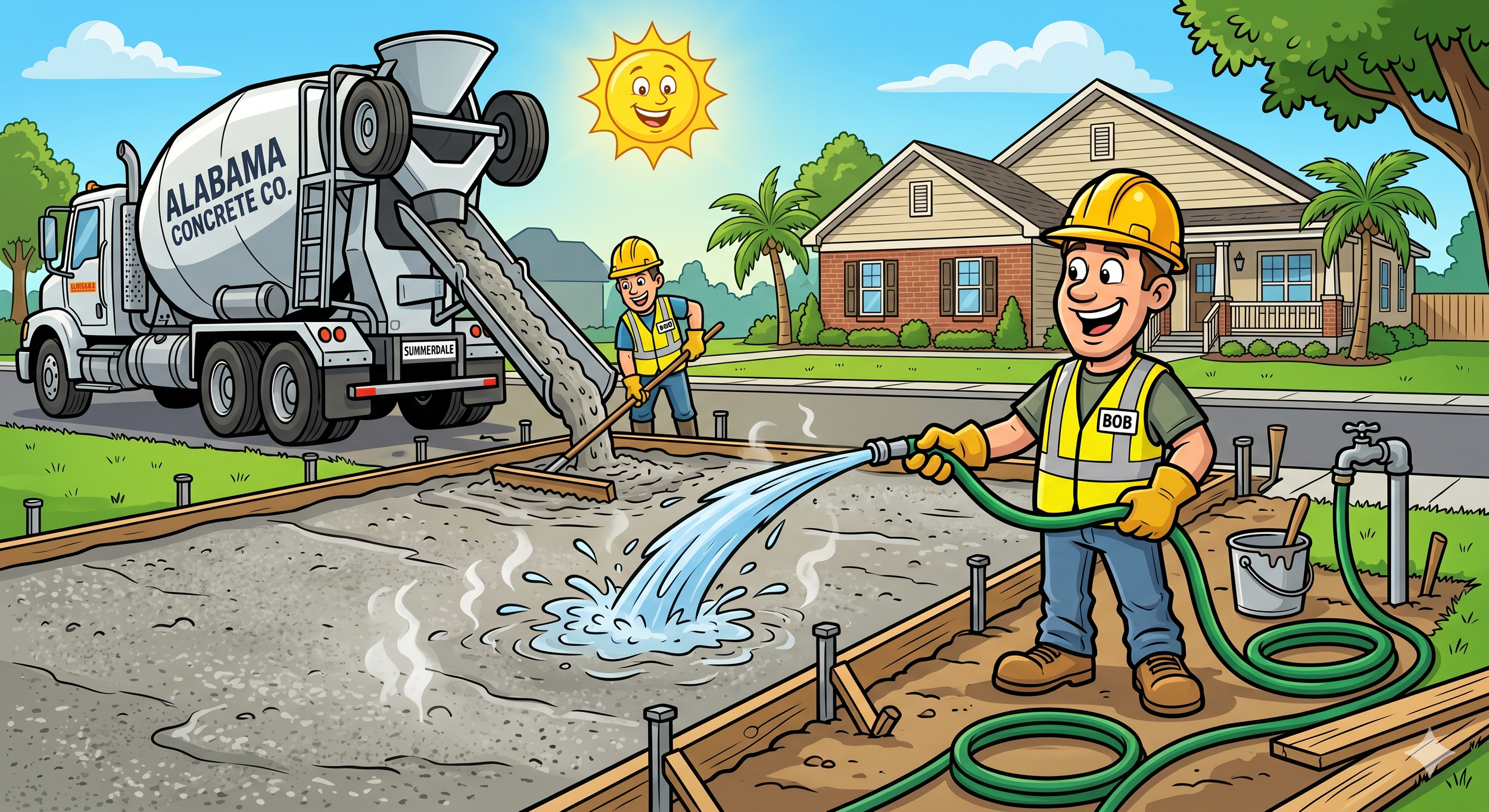
Spraying water on your concrete can cause major unseen damage that shows up later.
How to Fix It
Densify and Seal: If the surface is just a little chalky but otherwise solid, a professional can apply a chemical densifier that hardens the surface, followed by a quality sealer to protect it.
Rout and Seal Cracks: Small cracks can be cleaned out and filled with flexible polyurethane sealants to keep water from washing out the dirt beneath your slab.
Tear Out and Replace: If the driveway is heavily cracked, sinking, or crumbling all over, the only permanent fix is to remove it, fix the foundation beneath it, and pour fresh concrete using the correct mix.
Need a pro to take a look? Give our team a call today for an honest assessment of your driveway. We can tell you exactly which fix makes the most sense for your home!
Part 2: The Deep Dive (For the Concrete Nerds!)
Alright, let's geek out. If you want to know the actual chemistry and mechanics behind why South Alabama concrete surfaces fail, welcome to the deep dive. Concrete is a marvel of modern engineering, but it is highly susceptible to chemical imbalances if the contractor doesn't respect the water-to-cement ratio.
The Mechanics of "Dusting" and Weak Surfaces
That chalky powder on your shoes isn't dirt; it's unbonded cement and fine sand. This issue is almost entirely caused by a compromised water-to-cement (w/c) ratio at the surface.
The "Blessing" Effect: As concrete sits, heavier aggregates (gravel and sand) settle to the bottom, forcing excess water to the top. This is called bleed water. If a finisher trowels the concrete while this bleed water is present, or worse, if they actively spray water onto the surface to buy themselves more working time (often jokingly called "blessing the slab"), they drastically alter the chemistry of the top 1/8th inch of the concrete.
Laitance Formation: By working that extra water into the surface, the contractor dilutes the cement paste. When it finally dries, it leaves behind a porous, soft layer called laitance. This layer has virtually no abrasion resistance, which is why sweeping it or driving on it causes it to easily turn to chalky dust and eventually wear entirely away.
Rapid Evaporation and Curing Deficiencies
Concrete doesn't "dry"—it hardens through a chemical reaction called hydration, which requires moisture.
In our hot, humid, and often sunny climate, the surface temperature of the concrete can skyrocket. If the surface moisture evaporates faster than the bleed water can replace it, hydration stops prematurely.
The cement paste on the top layer never reaches its full compressive or tensile strength. This is why professional contractors will use chemical curing compounds or wet curing methods to trap the moisture inside the slab until the chemical reaction is complete.
Why Structural Cracking Happens
While dusting is a surface chemistry issue, cracking is structural. Concrete has fantastic compressive strength (handling heavy weight pushing down) but terrible flexural strength (handling bending).
Plastic Shrinkage Cracking: When the sun and wind cause rapid surface evaporation, the top volume of the concrete shrinks faster than the bottom volume. This creates a tearing effect, resulting in shallow, web-like cracking across the surface before the concrete has even fully hardened.
Subgrade Settling: If the subbase (the dirt/gravel underneath) yields or washes out from heavy rain, the concrete loses its uniform support. When a 5,000-pound truck parks over a hidden void, the concrete bends and snaps.
Thermal Expansion: Concrete expands in the summer heat and contracts when it cools down. If the control joints (the lines cut into your driveway) aren't cut deeply or quickly enough, the concrete will relieve its internal stress by cracking wherever it pleases rather than neatly inside the joint.
Advanced Remediation Chemistry
When fixing a dusted or weak surface, standard sealers often fail because there is no solid material for them to bond to.
Silicate Densifiers: To fix a chalky surface, we use lithium or sodium silicate densifiers. These chemicals penetrate the porous surface and react with the free calcium hydroxide (a byproduct of cement hydration) to form calcium silicate hydrate (CSH). This chemically binds the dust and physically hardens the surface, turning a soft slab into a solid, abrasion-resistant foundation.